 Menu
Menu
RichardHowe.com – Voices from Lowell & Beyond
Elections & Results
See historic Lowell election results and candidate biographies.
Why Do I Tell the Franco-American Story? by Paul Marion
With the annual Lowell area Franco-American week celebration coming up later this month, this seemed to be a good time to re-run this brief essay. There are two million descendants of French-Canadian immigrants in New England. In 2020, I was asked by the hosts of the French-Canadian Legacy Podcast in Concord, New Hampshire, to answer the question below. I wrote the following for the podcast blog.
Why Do I Tell the Franco-American Story?
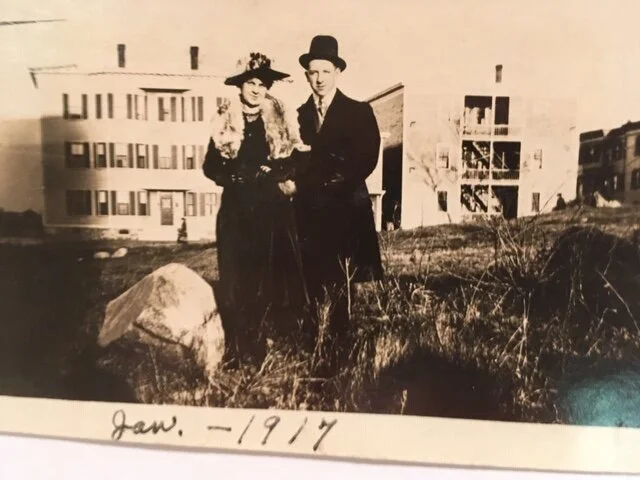
My grandparents, Antoinette and Wilfrid Marion, in Little Canada, Lowell, 1917
.
I believe it is important to know your roots. I believe that you have a better chance to know who you are if you know where you come from, if you know how you got to where you are today. Why is it important to know who you are? I believe you will lead a more fulfilling life if you have a sense of how you fit in the larger flow of humanity. It’s about what I call coherence, which I take to mean having a unified sense of being, a feeling of being whole in body and soul and mind. It’s the opposite of being alienated, the feeling of being disconnected from society. Knowing who you are and where you are gives a person a better chance of feeling a sense of community, a sense of belonging to something larger than your individual self.
The question “Who am I?” has the simplicity of the old Baltimore Catechism question, Who made me? In Catholic grade school a lot of answers were provided. Just memorize what’s in the book. Just listen to the priest at Mass. Just do what Sister Therese de L’Enfant de Jesus says. The authorities offered a lot of answers after providing the questions as well. But in all those school days in a French Catholic elementary school, I don’t recall any of the authorities telling us how the French Canadians wound up in Lowell or Dracut, Mass. There was no local history in school. They customs, yes, like singing the Canadian national anthem in French and displaying the Quebec province flag in the classroom next to the red, white, and blue U.S. flag. Sometimes the Mass was said in French. Early on it was in Latin in my day. Then it was English with the priest facing the faithful in the pews. “Pray, pay, and obey,” was the unspoken game plan.
We had a few “French” items in the school cafeteria like Chinese Pie or Pâté Chinois, the regional concoction that is a twist on Shepherd’s Pie or Cottage Pie from Ireland and Britain. Until the canonical law changed, we were not served any meat on Fridays. Gooey mac and cheese, tomato-rice soup, crispy fish sticks were popular. Some kids didn’t go for the hot lunch. We had French language day on Thursdays and French courses, grammar and conversation, all the time. At home my parents spoke French to my grandparents and their siblings (not all the time). We visited relatives on New Year’s Day, which is special for the French Canadian-Americans. The older generations told stories about the immigrants and subsequent generations. My ancestors on both sides came to Lowell, Mass., in 1880. Despite all this, my generation turned out to be highly American in identity.
As someone interested in history, I always had a sense of my past and was curious but not in any extraordinary way. I lost my ability to speak French fluently, even semi-fluently, after high school despite four years of French reading comprehension and conversation classes. One of my brothers attended a French Catholic high school, but I chose not to. As the years went on, I began to think more about my family’s origins. When my son was born in 1995, the sixth generation of our line in Lowell, he came to my wife Rosemary and me with her 100 percent Irish roots stretching back to 1870 in the city and my 100 percent French background. I realized that he would be far from his ethnic origins. It would be up to me to give him some grounding so that he would have an understanding of where he comes from. With any ethnic link, a special challenge is keeping in touch with the roots when a person no longer has the native language, whether French, Portuguese, Khmer, Spanish, whatever it may be. Our son’s arrival heightened my commitment to tell the French Canadian-American story in my writing, both the Lowell area French story and my family’s place in it. I’m still reconstructing the family experience. Fortunately, two of my aunts had researched the genealogy of the Marion and Roy lines as far back as the mid-1600s in Normandy, France. The paper trail doesn’t go back farther, so far. I’ll keep at it.
And so, as a writer, I have a way to tell the story of my family, my community, my people. The knowledge has added texture to my experience. Embracing the identity has opened up connections to other people in New England, in Quebec, around the U.S., and abroad. I’m part of a larger effort to remember. At the UMass Lowell Center for Lowell History, there’s a transcript of an interview with a French Canadian-American woman from Lowell from the 1980s. In it, she tells stories about the Lowell French in her time, early 20th century, and she sings songs. The lyrics are reproduced. Speaking to the interviewer, she says at one point, “I’m a memory worker.” That captures what’s going on in this telling of the French-Canadian story in America. Those of us who write, speak, sing, research, and more are all memory workers in the big Memory Bank.
— Paul Marion (c) 2020
Franco-American Week begins June 21

Lowell’s 2026 Franco-American Festival Week begins Sunday, June 21!
- Sunday, June 21: 12:00 pm Mass in French honoring St. Jean Baptiste. (French/English worship aid provided.) At Immaculate Conception Church, 144 E. Merrimack St., Lowell, MA. Refreshments and naming of the Greater-Lowell Franco-American of the Year will follow in downstairs church hall. (Stair-free access on Fayette St. for upper-church handicap drop-off. Downstairs lift accessible from the church parking lot, using door closest to E. Merrimack St.)
- Sunday, June 21: 4:00 pm “Celebrating Our French Heritage” with Soloist Marie-Line Morin at Joseph’s Shrine, 37 Lee St., Lowell, MA. A weaving of narrative and song in honor of the OMI fathers who staff the Shrine. On-street parking free on Sundays; free off-street lot nearby. For more information, contact: sjwssec@stjosephshrine.org
- Monday, June 22: 5:30-9:30 pm “Across the Years: Three Franco Poets from Lowell” at Coburn Hall, UMass Lowell South Beginning with Dr. Joseph H. Roy, Lowell has nurtured Franco poets including Loom Press publisher Paul Marion and Franco Committee member Suzanne Beebe. Join them for a reading and discussion of Dr. Roy’s and their own poems from a Lowell Franco perspective. Refreshments will be served.
- Wednesday, June 24: 10:00 am Lowell City Hall Flag Raising followed by coffee and (Outdoors if weather is favorable; in City Hall if rainy.)
- Wednesday, June 24: 6:30 pm Vesper Service honoring St. Jean Baptiste at the Lourdes Grotto, 357 Pawtucket St., Lowell, behind the Franco (Bring your own chair!) Wine and Cheese Social to follow in the Community Room of the Franco Residences.
- Thursday, June 25: 6:30-8:30 pm Family Bingo in French and English, at Michael’s Church Hall, 12 Sixth St, Lowell, MA. Bingo cards $2 each or three for $5. Cash prizes for each game! Free snacks and water!
- Saturday, June 27, 6:00-9:30 pm French Quadrilles and Contra Dances at the Pleasant Golf Club, 141 Staples St., Lowell, MA. Free admission! Acadian and Québecois fiddling from rising star Gus LaCasse of Maine. Dances called in French and English by Lowell’s Jeannine Ameduri. Franco foods, snacks, and water free of charge. (Cash bar!)
- Sunday, June 28: 1:30-4:00 pm Magic and Other Fun at St. Rita’s Church Hall, 158 Mammoth Rd, Lowell, MA. Magic show at 2:15 from Henri Marchand. Free face-painting, games, and snacks before and after!
A Tribute to the LRTA
A Tribute to the LRTA
By Leo Racicot
Due to a series of nerve-wracking experiences driving on the Wild West streets of Las Vegas for three years followed by working for a woman in Cambridge who wanted me to ride her autistic son around the city while he screamed at the top of his lungs like a banshee, I decided to let my driver’s license go, after over 30 years of driving. This perhaps too-impulsive act happened just at the time I was moving back to Lowell. Suddenly, I found myself needing to find a new way of getting around. I discovered that the Lowell transit system, the LRTA, had upped its services since the last time I lived here in 1993 to such a degree that its buses could and did take me everywhere I needed to go. For a long time, I’d take a bus then usually walk the rest of the way to my destination. But then, as happens with the aging process, my feet and legs began to fail me such that now, if I want to go somewhere, I have to travel bus-to-bus, eliminating the walking part of my journeys as much as I can.
I mention all this as a prelude to telling you that in nineteen years of bus travel, I’ve gotten to know nearly all the drivers, some in, if not intimate ways, then certainly in companionable ways that make the often long rides nothing short of sheer delight. I know all their names, their family histories, their ups, their downs. Not one of them (with the exception of maybe two) know or have cared to know my name or anything about me. They know I’m a regular, part of the bus culture that develops among commuters who use their buses on a regular basis. There’s a certain comfort, something I like very much about knowing them and them not knowing me. I like the anonymity. It’s certainly a bond apart from the usual relationships I’ve had: friends/a strong, lifelong sibling bond. Best of all, I like it when it happens that I’m the only one on the bus with the driver and I have him or her all to myself in conversation. I like, for example, two real characters, emigrants to America, both from Bulgaria: Costa and R.G. It tickles me that I should ever know anyone from Bulgaria, much less two. Both men wound up working for the LRTA who, though they of course know each other, admit they never socialize outside of work (different interests, I guess). Whenever I’m at a bus stop and Costa pulls up, it always makes my day. After he learned I worked in libraries, as I’m getting on the bus, he always announces (in a booming voice, I might add) “Librarians!” (plural, always the plural), Librarians are entering the bus!” and then add, in his heavy Eastern European accent, “Okay, now Librarians are sitting down on the bus!” I always get a kick out of this; however embarrassing this was at the start. I’ve gotten used to it, and came to feel I’m not just another bus riding drone. Because, no doubt about it, there is a certain stigma attached to people who have to ride buses. Costa makes me feel good about myself. I like learning about his past, his driving of cross-country semis, his time working for the U.S. embassy in Japan — before Costa, I held to the ignorant belief that all bus drivers must be uneducated dolts. But Costa is very intelligent and I’ve loved my chats with him through the years. There’s also, as I say, a certain stigma attached to people who have to ride buses to get around, an unspoken less than pathos. Many’s the time (too many), a passing car, as I’m waiting at the bus stop, people in cars have honked loudly when they catch sight of me there, especially in bad weather, the occupants of the car, usually teenagers, jeering at my, to them, pathetic situation. “Hey, look at the grown man, without a car, waiting in a blizzard for A BUS.
Truth is — I like and am so thankful for being able to ride the buses, like very much the sight, the voices. the “hellos” of the men and women I’ve come to know so well, or not well at all, as the case may be. One driver (actually two: Donna and Denise) were kind enough when they’d see me trudging along knee-deep in winter weather, to stop, pick me up and, though they probably weren’t supposed to do this, actually take me home to my door. Donna would always say, “It doesn’t cost anything to be kind.” I treasure the drivers. Some might be more grumpy than others (who wouldn’t be grumpy driving around in circles all day in sometimes heavy traffic, dispatchers barking at them on the radio, traffic cops directing them to take long detours, passengers who don’t know where they’re going or are loud or pay no attention to the rules (I once saw a student pull out a pungent Chinese takeout container from a bag and start scarfing it down as casually as you please, paying no attention to the NO FOOD/DRINK sign right in front of him. The job has to be a nightmare most days. It’s the consistently pleasant, cheerful, welcoming drivers who impress me so much, drivers like Kenny, like Robin, like Ellen, like Rachel, like the Buddha-like Asian fellow whose name I’ve never known, like Bob, whose good-natured teasing characterizes me as “The Philanthropist”, some poor schmuck who rides buses, walks all over town in his mission to hand wads of cash out to the needy. Bob, himself, would hand free bus tickets to me more times than I can count. Ellen would do this, too. Driver Carol’s funny-naughty comments always crack me up. .And, I miss Bill Berry who for years kept telling me that “every Saturday in summer, the Harley Davidson outlet on Boston Road has a free cookout — hot dogs, hamburgers, all the soda you can drink.” You gotta get over there”, he’d urge and add, “Then you hop on the #15 bus, get off at Kimball Farms and have a banana split for dessert!” I first came to know Ellen through her partner, Val. Val and I were coworkers with CTI back some forty years ago. Great gal. She drove for LRTA for years then transferred to dispatch where, for a lot more years, she worked as head dispatch (think she’s gone to part-time now) She and Ellen are two of the finest people I know. And when my sister, my only sibling, passed away and they found out I have no family left, they warmly, compassionately said to me, “You have us.” I believe they meant not only the two of them but the whole company and its drivers.
The LRTA drivers, their faces, their smiles, make life, esp. daily life, a little less hard. And when favorites have passed on: Norman Welch, Bill Desmond, Cheryl Houle, Jack Leahy, Sonny Brouillard, I’ve mourned them. I miss them. They’ve become, for me, and I know, for many others who travel with them, some of us for years, an extended family, a logical, needed extension of how we feel when we see familiar faces every day, even our fellow passengers. These friendly, joking faces bring a comfort, a continuity to our daily lives. And that, in this increasingly isolated, almost zombie-like, robotic society where the world that people see on their phones, on The Internet and TikTok can be more real to them than the person standing next to them at a traffic light, that can be everything.
_________________

Thank you LRTA

Kennedy Center

Sonny Brouillard

Rachel

Ellen P with Kenny in the driver’s seat

Sokhoeun
Seen & Heard: Vol. 23
In which I write about interesting things that I have read, heard and seen during the past week:
Destination: Concord Museum – Located at 53 Cambridge Turnpike, Concord Museum is not far from downtown Concord, Massachusetts. The mission of the museum is to share objects and stories about the many elements of the town’s history including its original Indigenous inhabitants; the arrival of the English; the accomplishments and challenges faced by the town’s Black residents; the accomplishments and challenges faced by the town’s female residents; the April 19, 1775, fight at the Old North Bridge that helped start the American Revolution; the town’s role in the abolitionist movement and the Civil War; the many writers of the Transcendentalist movement who lived in the town; and how the town has commemorated all of the above. If you want to understand what happened on April 18 & 19, 1775, this museum is a good place to start. A video storyboard map of the vicinity with accompanying narration provides a timeline of the British advance from and retreat back to Boston and all that happened in between. Period artifacts such as one of the two lamps that hung in the steeple of the Old North Church that evening, enrich the story. I’ve been to Concord Museum many times but I visited it again to see a temporary exhibit called “Revolutionary Legacies” that uses artifacts to explore how the events of April 19th have been remembered and celebrated and how commemorations like the 250th of the founding of the United States cause us to reflect not just on the past but also on how we see our legacy in the future.
Podcast: Impolitic with John Heilemann – On this episode, host John Heilemann interviewed Josh Tyrangiel, a contributor to The Atlantic who discussed his new book, AI For Good: How Real People Are Using Artificial Intelligence to Fix Things That Matter. The book grew out of a column on AI that Tyrangiel wrote for The Washington Post in which he found people in different fields, mostly outside of Silicon Valley, who were finding new and innovative ways in which artificial intelligence could help them do their jobs better. I haven’t read the book and probably won’t, not because I don’t find the topic interesting but because I have so many other books waiting to be read that I’ll never get to it. But I do find the topic of how to use AI to be fascinating and in this hourlong podcast, Tyrangiel seemed clear-eyed about the possibilities but also the challenges. A big part of all the jobs I have held in my life (Army intelligence officer, lawyer, register of deeds) and in my current avocation as an historian, has been finding and managing information. Since my first experience with a word processor in the early 1980s, I’ve been convinced that computers are a terrific tool for helping with those tasks. From my first use of ChatGPT in December 2022, I saw the enormous potential of AI and nothing I’ve seen since has changed that opinion. That’s the “glass is half full” view of AI. The “glass is half empty” take which Tyrangiel and I share, is that the people who are the chief spokespersons for AI are also the one who stand to benefit the most from it financially. They are also the same people who assured us that social media would be such a positive good for society. That turned out to be about as far from the truth as you can get, so these guys (and they always seem to be males) have no credibility. Their embrace of Trumpism also demonstrates that they have no regard for ordinary people. They want to maximize their power and profits and will ally themselves with whichever political leaders will help facilitate that. For that reason, I see the groundswell of opposition to AI – most recently in fights against data centers and college graduates booing commencement speakers who speak approvingly of AI – as well-founded. For all the good that AI might provide, its current trajectory will eliminate hundreds of thousands of jobs with no provision for what the displaced employees will do. If our government was looking out for the best interests of regular people, it would be imposing taxes on profits derived from AI to fund retraining and support for those who lose their jobs. The middle part of our country was shattered by unmanaged deindustrialization in the 1990s and we’re on that same pathway again. However, because of unlimited campaign spending, our government now seems to work for those who profit the most from things like AI and those people have no interest in reducing their profits and power for any reason, so there has been no meaningful effort from either party to address this problem.
YouTube: Conan O’Brien Commencement Address at Harvard – Conan O’Brien, Harvard class of 1985, returned to the school on May 28, 2026, to deliver this year’s commencement address. Employing his well-known sense of humor and a heavy dose of self-deprecation, O’Brien delivered many insider remarks about life at the school that would have been particularly entertaining to the graduates. He also made some serious points, telling graduates to wear their Ivy League degrees lightly, making it “the least important thing people know about you.” He criticized the current regime in Washington, saying they viewed empathy as a weakness and acted like America stands “supreme and alone.” At the same time, O’Brien lauded the vital contributions of international students to American society.
Book Review: The World’s Banker: A Story of Failed States, Financial Crises, and the Wealth and Poverty of Nations” by Sebastian Mallaby (2004). Most of us have heard of the World Bank but few know anything about it. Recently I heard a podcast interview of Sebastian Mallaby, a longtime journalist who has written a handful of nonfiction books. While the podcast topic was a more recent book, Mallaby talked a bit about his 2004 biography of James Wolfensohn (1933 to 2020), an Australian-born investment banker who served as the president of the World Bank from 1995 to 2005. Established along with the International Money Fund in 1944 at the Bretton Woods Conference to help rebuild countries devastated by World War II, the World Bank continues to operate as an international financial institution providing low-interest loans, grants, and technical assistance to developing nations, aiming to reduce global poverty and promote sustainable economic growth. Wolfensohn gained prominence for his role in bringing Chrysler out of bankruptcy and led Carnegie Hall and the Kennedy Center. He was nominated for the presidency of the World Bank by President Bill Clinton (it’s an international institution but since the US is the largest investor, its nominee is usually elected president). This book documents the turbulence experienced by the World Bank during Wolfensohn’s tenure from internal factors (bureaucratic infighting; attempts to reform the culture and operational rules; dealing with NGOs) and external factors (the war in Bosnia; the AIDs epidemic; the 9/11 terrorist attacks; and the Iraq War). Mallaby’s assessment of Wolfensohn’s tenure is mixed: he tackled some tough issues that needed to be addressed but he sometimes fell into the frequent trap that the management practices of American private industry are sometimes not all that they are made out to be in the media and therefore are not always appropriate for emulation in government and government-adjacent institutions.